

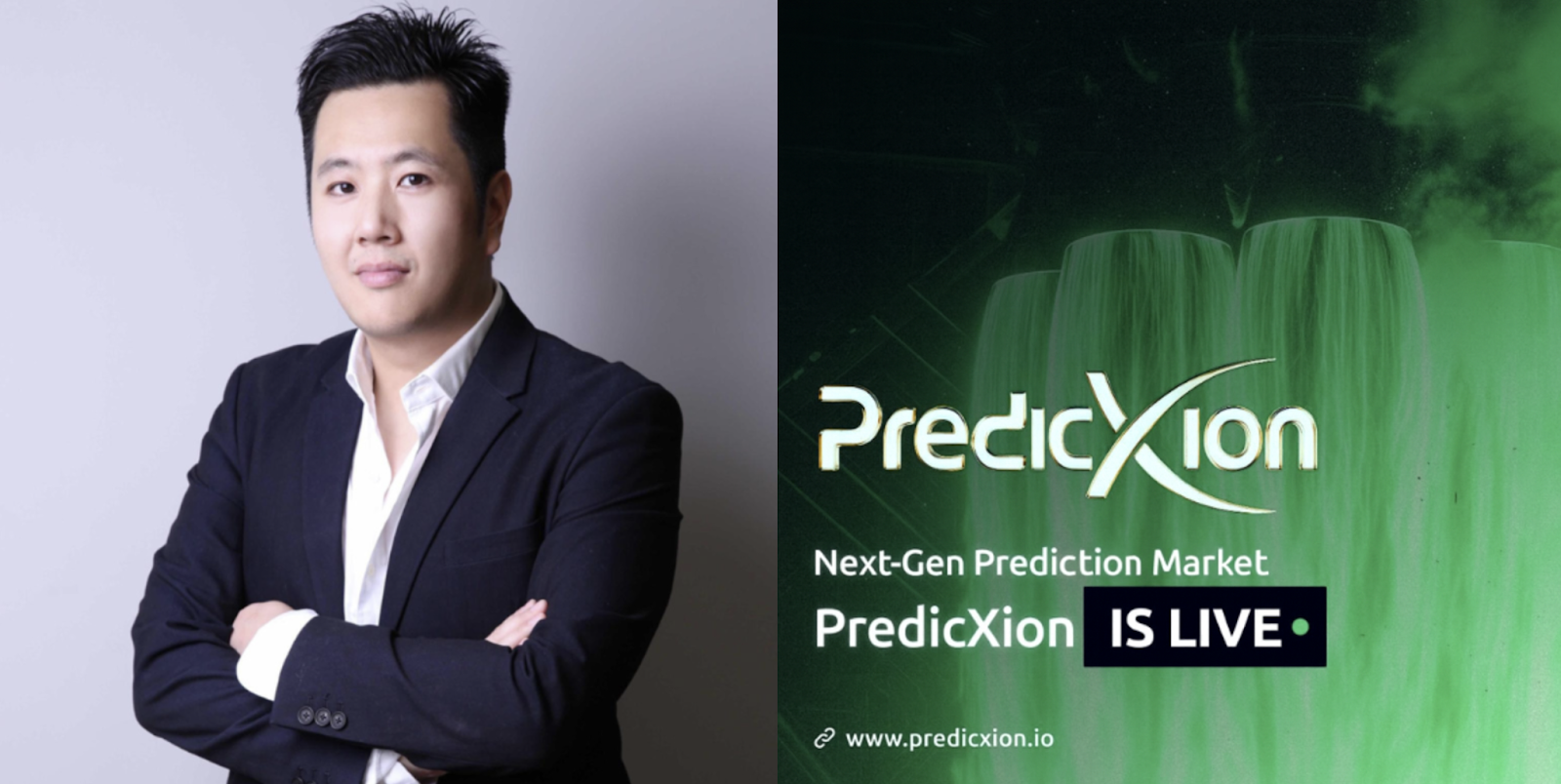

On a late summer night in the heart of Asia’s trading zone, Andy Cheung is thinking less about tokens than probabilities. The man who once lived inside the chaos of crypto exchanges now studies a different kind of volatility: not just how assets move, but how belief forms, hardens, and breaks in real time. A decade spent running and reshaping high‑velocity platforms has convinced him that speculation, handled correctly, can be more than a game. It can be a lens. PredicXion, the AI‑powered prediction and information market he co‑founded, is his attempt to build that lens for the Asia‑Pacific region—and, increasingly, for underrepresented markets beyond it.
The core question he is chasing is deceptively simple: in a world that no longer trusts polls, pundits, search engines, or feeds, where do people go to see what others really think will happen next? PredicXion’s answer is to force belief into the open. On the platform, users create and trade markets tied to concrete events in politics, finance, sports, and culture, backing their views with an internal unit of account, pdUSD, rather than likes or retweets. As the team puts it in its own materials, “PredicXion is an AI-powered prediction market platform where users can create and trade on event-driven markets across politics, finance, sports, and pop culture. It uses a centralized execution engine with predefined and audited data sources for settlement, combining the usability of a modern exchange with the creativity of a content platform.”
Cheung describes the ambition in straightforward terms. “We aim to set the standard for APAC by offering a transparent, high-integrity platform where users can turn insights about real-world events into data-driven forecasts,” he says, positioning the company not just as another Web3 product but as a critical information infrastructure for the region. In his view, the region does not just need another trading app; it needs an information layer that can be trusted by users, partners, and eventually regulators.
An APAC‑first Experiment In Truth
PredicXion’s distinctiveness begins with where it has chosen to plant its flag. While some of the most visible prediction markets today are U.S.‑centric—Polymarket for crypto‑native traders, Kalshi for regulated economic and policy contracts—PredicXion is built unapologetically as an APAC‑first platform. “APAC-first focus: Markets and content are tailored to Asia-Pacific audiences, with regional events, languages, and time zones prioritized from day one,” the team explains when asked what sets it apart. For Cheung, that focus is not a marketing line; it is the thesis. To become the benchmark prediction market in Asia, they argue, the platform has to feel native to the region’s rhythms from day one.
The product combines the usability of a modern exchange with the flexibility of a content platform. Under the hood, it runs on the centralized execution engine the team describes, with predefined and audited data sources to determine how each market settles. Around that core sit tools designed explicitly for partners and communities. As PredicXion’s own positioning puts it, “Creator-led model: Partners, media companies, KOLs, and communities can create and host their own markets, sharing in the economics of engagement. Centralized infrastructure, transparent outcomes: Unlike purely on-chain DEX models, PredicXion uses a centralized matching engine plus predefined, publicly disclosed data sources and outcome audits to reduce manipulation and oracle risk. AI-assisted market creation: AI helps surface trending topics, auto-generate event descriptions, and suggest price ranges, making it faster to launch high-quality markets.”
That structure points to a deeper ambition. PredicXion is not only a place to trade; it is designed as a creator‑ and trader‑led ecosystem. A news organization covering an election might embed a live market next to its analysis; a finance community could host ongoing markets around rate decisions or earnings; a pop‑culture collective might spin up markets on award shows or fandom milestones. In each case, the market does double duty—as entertainment and as a live barometer of crowd expectations.
From Gambling Stereotype To Information Market
Cheung is acutely aware of the baggage that comes with the phrase “prediction market.” For many, it still evokes betting slips and offshore sites, not a tool for understanding the world. Part of PredicXion’s mission is to shift that perception by insisting on a broader term alongside it: information market. The distinction matters. Where a betting product stops at the thrill of being right or wrong, an information market treats that outcome—and the odds that preceded it—as data that should feed back into how people form judgments.
In their internal narrative, information markets are simply the next stage in how societies organize knowledge. Web1 organized documents; Web2 organized social signals; Web3 put value on‑chain; AI organized past patterns into plausible responses. Information markets, as PredicXion defines them, organize expectations. That conviction shows up starkly in the way the team talks about the future: “We believe that information markets and prediction markets will ultimately replace traditional AIs, social media, and search engines as the new, real-time golden source of truth for the world,” Patrick Lam, PredicXion’s Chief Strategy Officer, says. What looks today like a niche Web3 product, in this telling, is meant to become the first stop when people want to understand facts, preferences, or consensus on any question that matters.
When Lam breaks down PredicXion’s value proposition, he likes to do it by audience. “PredicXion solves three core problems,” the team explains. “For users: It provides a simple, mobile-friendly way to express views on real-world events and see crowd-driven probabilities in real time. For creators and brands: It offers an interactive format to engage audiences beyond static content, turning attention into measurable sentiment and new revenue streams. For partners and analysts: It aggregates forward-looking signals on politics, markets, and culture, offering an alternative data source for understanding public expectations.” The company’s roadmap reflects that triptych: build a vibrant user base, empower creators, and turn the resulting data into something institutions can rely on.
In the short term, the focus is on deepening that creator‑ and trader‑led base across Asia‑Pacific, where early traction has already drawn attention from observers in other regions. In the medium term, PredicXion plans to move more aggressively into underrepresented regions such as Africa and to build strategic partnerships with institutions that see value in forward‑looking sentiment data. Long term, the goal is to establish a globally recognized benchmark for compliant, AI‑powered prediction and information markets, with clear and audited outcome standards that regulators and partners can scrutinize.
Building A Benchmark In An Age of Doubt
The timing of this effort is not incidental. Trust in traditional institutions is fraying; polls regularly miss; social media rewards outrage more than accuracy; even AI—capable of generating polished prose on demand—can hallucinate confidently. Cheung’s view is that none of these tools can be discarded, but all of them need a check. That check, he argues, is best provided by systems in which people do more than talk: they commit. In this sense, every market on PredicXion is a small act of discipline. It forces a trader, a creator, or a casual user to ask whether a belief is strong enough to back with capital, even in small amounts.
The platform’s analytics dashboards are built around that idea. Rather than burying odds in complex interfaces, PredicXion surfaces probabilities and sentiment in ways that are meant to be legible not only to professional traders but also to journalists, analysts, and everyday users. An election market, for example, becomes an evolving chart of implied chances rather than a static prediction; a macro market on interest rates becomes a living poll with skin in the game. For partners and institutions, this provides an alternative data source that is inherently forward‑looking and continuously updated.
Inside the company, this is accompanied by a sober acknowledgment that none of it will matter if PredicXion cannot reach institutional scale. That is why, despite operating as a fully self-sustaining team today, the team is explicit about fundraising now. Cheung sees capital not as a vanity milestone but as a moat: a way to solidify PredicXion’s position as the APAC benchmark before copycats emerge, and to invest in compliance, auditing, and infrastructure that can withstand scrutiny. The fundraising narrative is also part of how they talk to would‑be partners. It signals that they are building not a fleeting app but a piece of market infrastructure they expect to live alongside exchanges, data providers, and research houses.
For Cheung, this ambition still comes back to something intuitive. Most people, he notes, already use informal prediction markets in their lives—they watch odds in election coverage, they scan analyst targets, they gauge sentiment in group chats. PredicXion’s job is to formalize that behavior in a way that is transparent, auditable, and regionally grounded.
In the end, the story PredicXion is trying to tell is not just about one founder’s journey from crypto exchange warfare to a more reflective kind of market design. It is about whether societies will accept a new kind of scoreboard—one that measures not just what has happened, but what we collectively think will happen next. Cheung and Lam are betting that in APAC and beyond, people are ready for that shift. The markets on PredicXion will render the verdict, one probability curve at a time.