

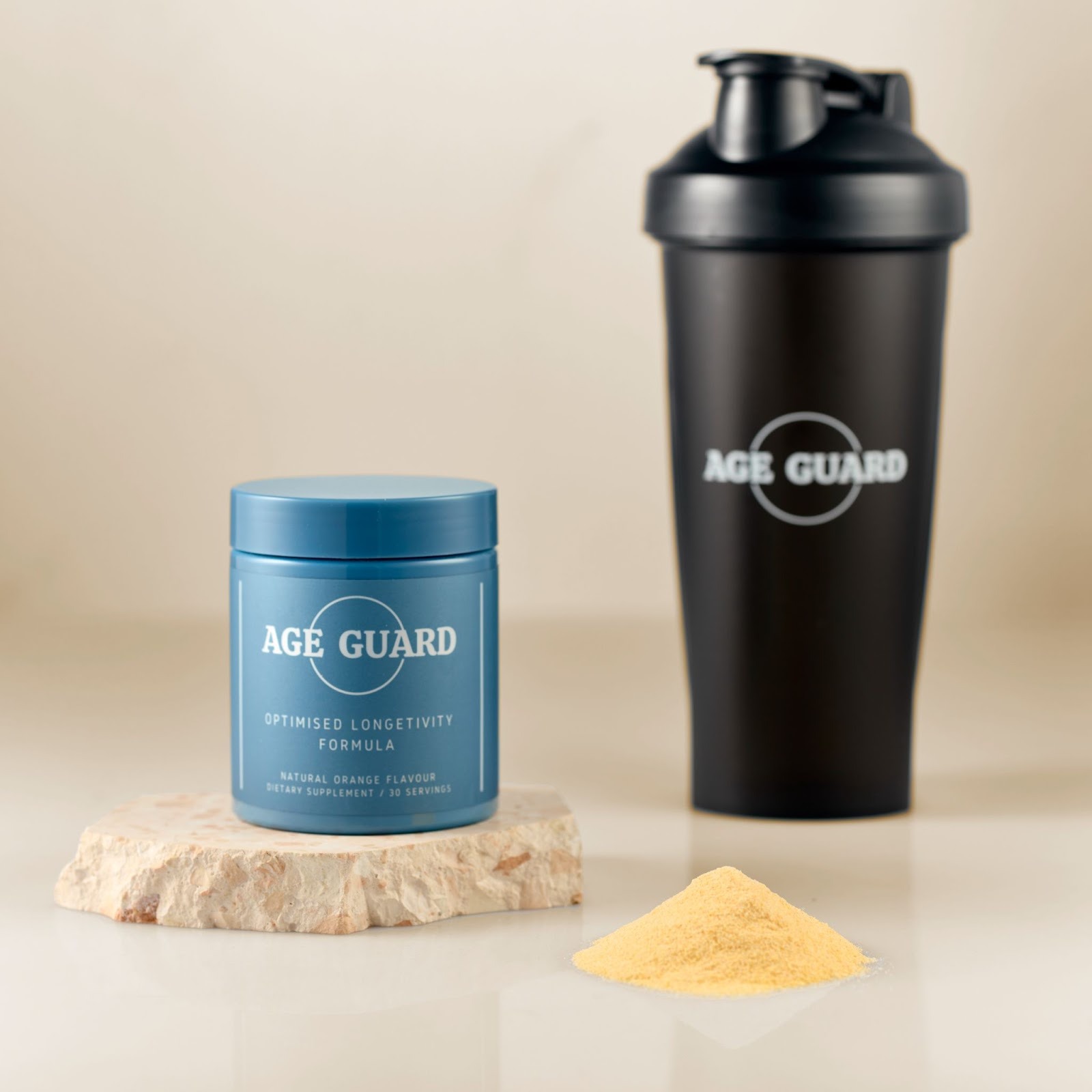

What all the fuss is about, in the end, is not youth itself but control. A customer in her 50’s describes a simple ritual she never expected to care about: one scoop of orange‑tinted powder, water, a pause before the first sip. A year earlier she had cycled through half a dozen “anti‑aging” products whose ingredient lists read like alphabet soup and delivered almost nothing she could feel. Now she points to specifics—steadier afternoon energy, better sleep, people suddenly commenting on her skin and hair. With more than 6,500 customers and thousands of five‑star reviews, Age Guard’s all‑in‑one longevity formula has quietly become a presence in the health and supplements world, suggesting a single, meticulously designed product can cut through a market long dominated by maximalist promises and minimalist results.
Behind that shaker bottle is a company that describes itself in almost monastic terms: one product, one passion. Age Guard is an all‑in‑one, optimised longevity formula built around 10 of the most researched anti‑aging ingredients, each included at doses aligned with clinical trial data. Rather than inviting customers to assemble a “stack” of separate pills, it compresses a decade of emerging longevity research into a once‑daily powder meant to slip easily into an existing routine. The core bet is clear: that a clinically dosed, transparent longevity formula can stand out in a skeptical but still deeply motivated market.
A Formula Built From evidence
To understand why Age Guard has attracted attention, it helps to start with what it is not. It is not a kitchen‑sink multivitamin that equates long ingredient lists with sophistication. It is not built around a single miracle molecule wrapped in inflated marketing copy. Instead, it is a deliberately constrained blend of 10 research‑backed ingredients—among them NMN, Niagen (NR), spermidine, collagen peptides, CoQ10, hyaluronic acid, TMG, curcumin, vitamin D, and vitamin E—each present at doses chosen to mirror or approximate those used in clinical trials. Some of these studies, and the logic behind the dosing, are set out directly on Age Guard’s research pages, an unusual level of transparency in a supplement category still dominated by proprietary language.
The centerpiece is NMN (nicotinamide mononucleotide), a compound that has become a focal point of longevity science for its role in boosting NAD⁺, the coenzyme essential to energy metabolism, DNA repair, and cellular resilience. In human studies, NMN has been associated with increases in blood NAD⁺ levels, improvements in physical performance, and favorable changes in markers linked to biological age. Age Guard uses a clinically aligned NMN dose, framing it not as a speculative add‑on but as the structural core of the product and its focus on cellular repair.
Around that core, the rest of the formula traces a map of modern longevity thinking. Niagen offers a second route to elevating NAD⁺, with research suggesting benefits for vascular and metabolic health. Spermidine, studied for its role in autophagy, has been linked to memory support and cardiovascular resilience. Collagen peptides and hyaluronic acid address skin elasticity and hydration, with clinical work showing reductions in wrinkles and improvements in dermal structure. CoQ10, curcumin, vitamin D, and vitamin E contribute to mitochondrial support, inflammation control, immune function, and antioxidant defense. Taken together, these compounds are designed to target major levers of healthy aging—cellular repair, structural integrity, and inflammatory balance—within a single, coherent system rather than as a pile of disconnected pills.
Solving The Problem of Scattered Supplements
Age Guard emerged into an industry where consumers are better informed than ever yet still confronted with products that lean heavily on branding while skimping on substance. Many longevity‑themed supplements offer impressive‑sounding blends, but closer inspection reveals under‑dosed actives, fillers, or overlapping compounds that do little beyond inflating a label. For health‑conscious customers trying to support NAD⁺, skin health, and cognitive function at once, the result is often a cupboard of half‑used bottles and a sense that no one is orchestrating the whole picture.
Age Guard’s answer to that fragmentation is unapologetically minimalist: one scoop, once a day, one product to anchor a long‑term routine. The company focuses on what it considers essential—“efficacy over excess”—and leaves out the long tail of trendy add‑ons that rarely reach meaningful levels in the bloodstream. That decision reframes the relationship between customer and product: instead of forcing people to act as their own formulators, cross‑checking doses and interactions, Age Guard positions itself as a rigorously curated baseline aligned with the available data.
The problems the formula aims to address are broad but specific: boosting NAD⁺ for improved cellular repair; enhancing skin hydration and firmness while reducing wrinkles; supporting cardiovascular and cognitive health; and promoting energy, endurance, and overall vitality. These aims correspond closely to the four most common benefits reported by Age Guard’s customers: higher day‑long energy, better sleep quality, sharper mental clarity, and noticeable changes in skin and hair. The brand talks less about “turning back the clock” and more about making that clock feel less punitive, shifting the focus from additional years in the abstract to the quality of the years people are already likely to live.
Innovation, in this framing, lies less in inventing new molecules than in assembling what already works into something people will actually use every day. The company believes no other product on the market comes close to its particular blend and dosing strategy, and it points to the consistency between clinical findings and customer feedback as evidence that this synthesis matters. Where much of the industry still treats anti‑aging compounds as isolated stars, Age Guard’s bet is that the real value lies in the ensemble—and in removing the friction that keeps many people from sustaining a serious regimen.
Listening To 6,500 Experiments
In a sector often criticized for its lack of feedback loops, another defining feature is the volume and clarity of real‑world data flowing back from customers. Since launch, more than 6,500 people have tried the product, leaving over 3,000 five‑star reviews. Across those testimonials, patterns repeat with unusual regularity: reports of higher, more stable energy; deeper, more restorative sleep; improved focus and mental sharpness; and visible upgrades in skin texture and hair quality. These individual narratives are not clinical trials, but collectively they function like thousands of small experiments, offering a living cross‑section of how the formula performs outside controlled conditions.
Inside the company, there is a striking reluctance to declare victory. When asked about milestones, the team tends to say that the most important ones are yet to come. Current adoption is treated as early validation of a thesis rather than a final verdict. That stance reflects an awareness of the gap between supplements and regulated therapeutics, and a recognition that the science of human longevity is still in its relative infancy. It also hints at a larger ambition: not just to ride the longevity wave, but to help shape a more evidence‑literate supplement culture in which customers expect to see sourcing, dosing logic, and research rationales laid bare.
That ambition shows up in small but telling choices. The Age Guard website does not simply list ingredients; it links them to summaries of clinical studies, inviting readers to examine the underlying data for NMN, Niagen, spermidine, collagen, and other key components. The brand is explicit that its product is a dietary supplement, not a drug, and that it is not intended to diagnose, treat, cure, or prevent disease. For a category long haunted by overpromising, this combination of confidence and caution may be its most radical move.
What, then, is all the fuss about? The company’s own answer is understated. People, it suggests, are not chasing immortality. They are chasing the ability to meet their grandchildren on their own terms, to keep working on what they love, to wake up and feel like their body is an ally rather than an obstacle. In that sense, Age Guard is not simply selling a scoop of powder. It is offering a story about aging that feels both technologically current and emotionally familiar—a story in which the most meaningful outcome is not to live forever, but to live long enough, and well enough, for a life to feel complete.