

For decades, companies with a presence in multiple countries have struggled with one of the most persistent challenges in workforce management: making sense of time. Every clock-in, absence, or leave request triggers a complex web of country-specific labor laws, collective bargaining agreements, and company policies. The process of manually interpreting these inputs for payroll or compliance consumes hours of administrative work, introduces human error, and exposes organizations to compliance risks.
Mercans, a London-based global provider of payroll and human resources software solutions, believes that the challenge can now be solved through automation. It recently launched an artificial intelligence-powered Workforce Management and Leave Management Engine that evaluates time and attendance data across countries, converting previously unevaluated workforce data into payroll-ready transactions. Mercans describes this as a new way to handle global compliance at scale.
Turning Raw Data Into Global Intelligence
Most conventional timekeeping systems record raw data, such as clock-ins, clock-outs, breaks, and leave entries, which still require interpretation before they can be used for payroll. A time entry that counts as regular work in one country might qualify as overtime or weekend pay in another, so companies traditionally employ human resources and payroll teams responsible for manually decoding these nuances.
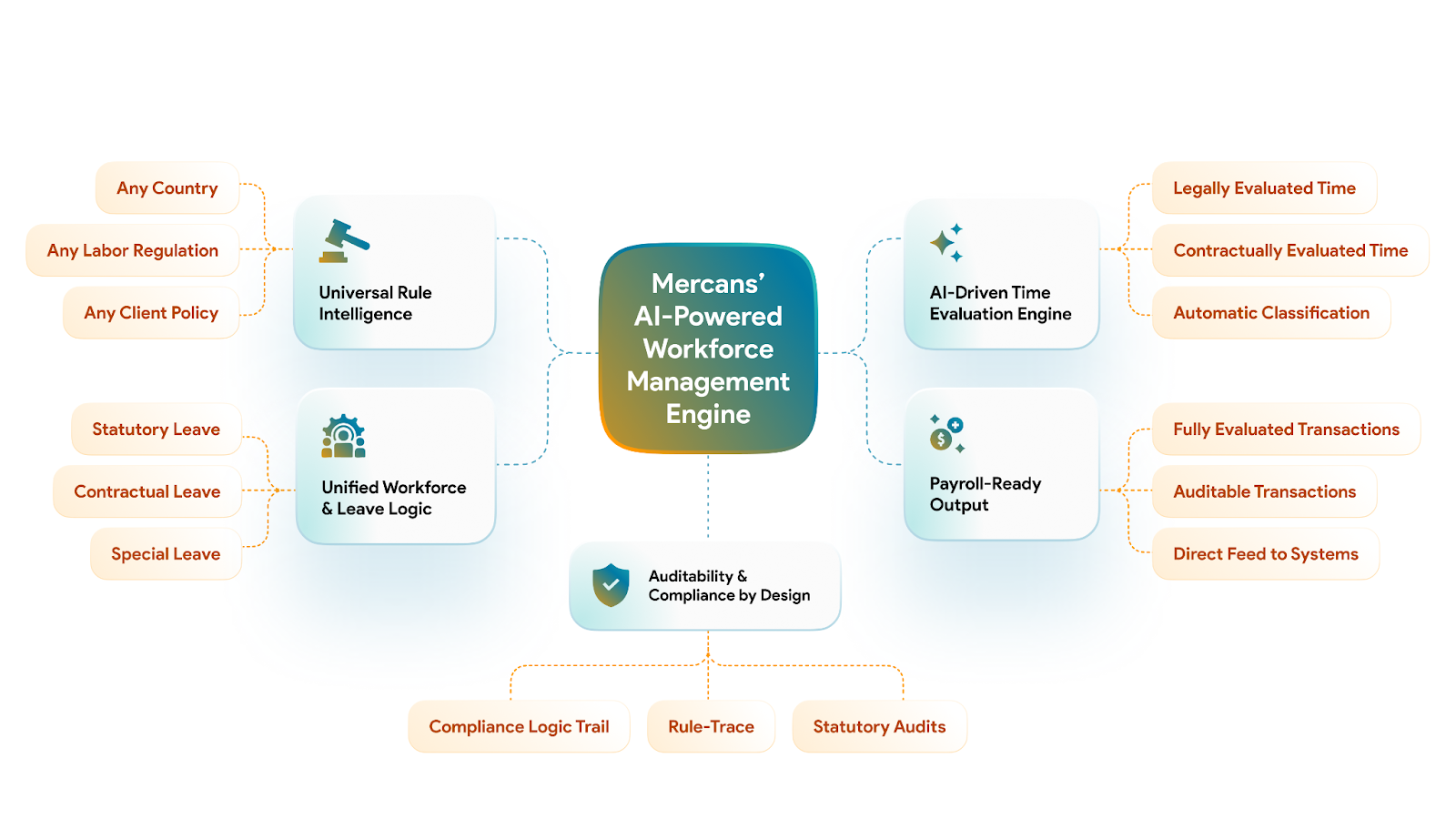
Mercans’ new engine automates that translation process. It ingests unevaluated time and attendance records and evaluates them using large rule sets that represent labor legislation, company policies, collective bargaining agreements, and exceptions, according to the company. Once processed, the engine produces transactions that are designed to be compliant with both country-specific requirements and individual organizational standards, ready for payroll and financial systems without additional manual interpretation.
The result, as framed by Mercans, is a level of consistency and accuracy that aims to reduce reliance on manual checks for routine scenarios. Each transaction generated by the system includes a compliance trail, designed to support transparency and audit readiness for labor authorities and internal governance teams.
A Compliance-First Approach For Global Enterprises
Mercans positions its engine as a tool for multinational enterprises operating across multiple jurisdictions, as well as industries where labor compliance is particularly dynamic or complex. From manufacturing and logistics to healthcare and hybrid workforces, organizations with multi-country payroll structures can centralize compliance evaluation in a single platform, eliminating the need to build and maintain country-by-country customizations.
The company characterizes the launch as a departure from the traditional assumption that time and attendance must be interpreted manually in each country. In comments shared by Mercans, group CEO Tatjana Domovits emphasizes that the technology is intended not only to track time, but to understand it in the context of law, policy, and contractual obligation, creating what the company calls a single global language for workforce transactions.
This unified approach enables companies to separate the process of capturing time data from the evaluation of it. In practice, businesses can continue using existing time-capture solutions such as biometric systems, mobile apps, or web-based tools, while relying on Mercans’ engine as the centralized source of evaluated, compliance-ready workforce data.
Bridging Workforce Needs and Business Efficiency
For employees, the transformation may seem subtle but is nonetheless meaningful. Automated evaluation can help reduce delays in payroll processing and minimize the risk of underpayment or miscalculated leave balances, outcomes that directly affect trust in employers and HR systems. For businesses, it has the potential to cut administrative overhead and lower the risk of compliance breaches that could result in fines, back payments, or legal disputes.
As workforces become increasingly distributed and regulatory environments become more complex, this type of automation provides a path toward stability and clearer expectations. Human resources professionals no longer need to spend as much time memorizing local labor codes or manually validating exceptions, and can instead focus on analysis and workforce strategy, while repetitive rule evaluation is handled by software designed for precision and policy alignment.
By combining its regulatory expertise with artificial intelligence, Mercans presents its engine as a foundation for what it describes as “globally intelligent workforce management.” The technology is designed to support current compliance needs while adapting to evolving cross-border regulations and flexible work arrangements.
Building A Global Standard For Time Management
Mercans’ platform arrives in a market where demand for compliant, scalable HR technology is accelerating. Organizations are increasingly seeking integrated tools that combine payroll, time management, and regulatory compliance, while reducing data fragmentation and manual reconciliation. With its real-time evaluations and audit-focused transaction trails, the engine provides an example of how global enterprises can streamline HR operations without compromising visibility or control.
Ultimately, it represents a shift from administrative labor to analytical insight. What begins as a simple clock-in now feeds a system built to understand legal, contractual, and organizational contexts, transforming routine inputs into structured, evaluated data. For global companies and their employees alike, that shift has the potential to redefine how efficiency and fairness are delivered in workforce management, transforming time data from a daily chore into a strategic asset.