
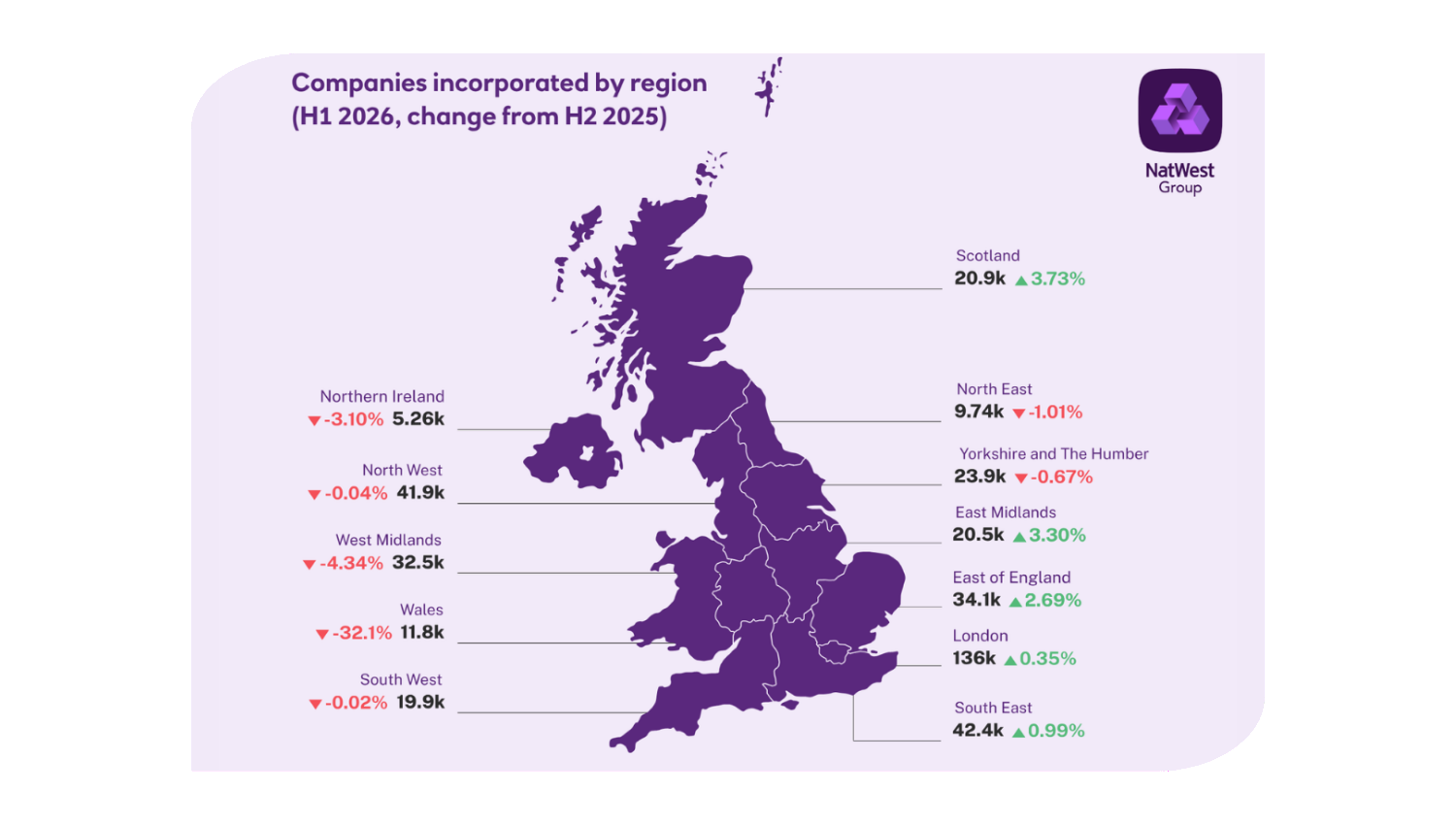

Scotland has posted the fastest growth in new company formation of any part of the United Kingdom in the first half of 2026, according to figures charting where businesses are being incorporated across the country. Some 20,900 new companies were registered in Scotland over the period, a rise of 3.73 percent on the second half of 2025 and the largest increase recorded by any UK nation or region.
The Scottish figure stands out against a mixed national picture. London remained comfortably the biggest single centre for new businesses by sheer volume, with around 136,000 incorporations, but its growth was almost flat at 0.35 percent. The next largest gains after Scotland came in the East Midlands, up 3.30 percent to 20,500, and the East of England, up 2.69 percent to 34,100.
Several regions moved the other way. Wales saw the steepest fall, with new incorporations down 32.1 percent to 11,800, while the West Midlands dropped 4.34 percent and Northern Ireland fell 3.10 percent. Yorkshire and the Humber, the North West, the North East and the South West all recorded smaller declines, leaving Scotland and a cluster of eastern regions as the main sources of momentum.
The pattern points to a business-formation landscape that is no longer driven by the traditional dominance of the South East alone. While London still accounts for the greatest number of new firms, the pace of new-company creation has shifted toward Scotland and parts of the Midlands and east of England, where founders continued to register businesses even as activity cooled elsewhere.
For Scotland, the numbers offer an encouraging signal about the health of its entrepreneurial base. Rising incorporations suggest a steady flow of people willing to start out on their own, from technology ventures and professional services to smaller trading businesses. New company registrations are an imperfect measure, since not every incorporation becomes a lasting employer, but a sustained increase is generally read as a sign of confidence.
The wider question is whether the growth can hold. Higher borrowing costs, soft consumer demand and rising employment expenses have made the early years harder for many young firms, which is part of what lies behind the falls seen in other regions. Against that backdrop, Scotland’s position at the top of the growth table marks a notable moment, and one its business community will be keen to sustain into the second half of the year.