
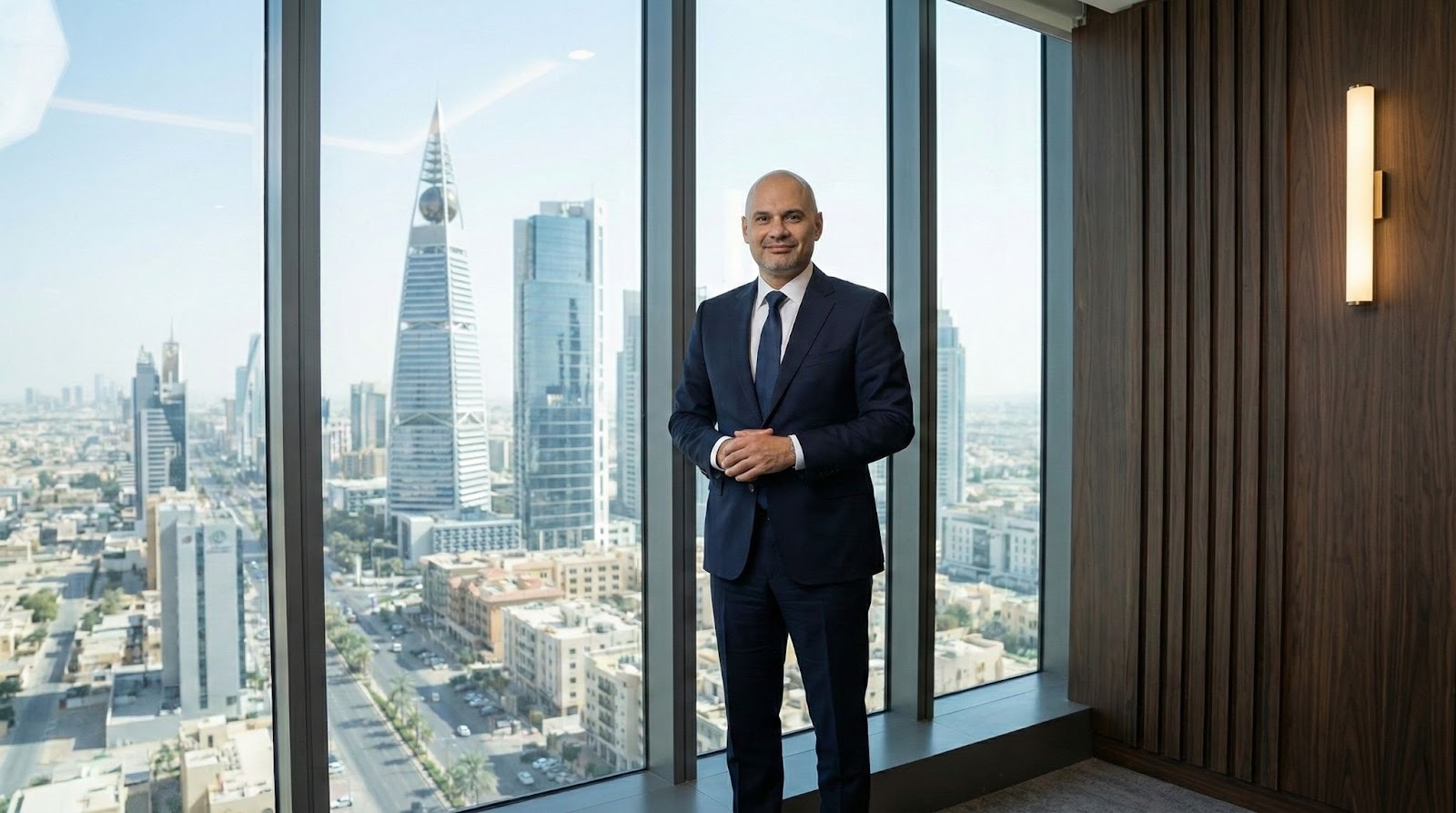

On Riyadh’s metropolitan edge, where desert meets concrete and steel, Cem Cesur leads one of the Gulf region’s most demanding urban developments. This 35,000-unit housing complex will eventually house approximately 250,000 residents.
The Al Fursan Housing Complex, where Cesur serves as project director for Dar Al Riyadh, includes fourteen million square meters and represents a test case for Saudi Arabia’s efforts to address its housing crisis while meeting the sustainability objectives of Vision 2030. The scale is unforgiving: dozens of contractors, government agencies, and technical specialists must coordinate across multiple construction phases, while adhering to budget limits and delivery schedules that allow little margin for error. For his work on this and other infrastructure initiatives across the Middle East, Cesur received a 2025 Global Recognition Award.
With over two decades of infrastructure work in Saudi Arabia, Bahrain, Oman, and the United Arab Emirates, Cesur has addressed housing shortages and environmental systems that have reshaped how cities manage growth. His projects have delivered more than 40,000 housing units and environmental infrastructure, serving 1.5 million people, and have applied construction technologies that have generated efficiency improvements exceeding 20 percent. His portfolio includes the WYNN Al Marjan Resort project in Ras Al Khaimah, the first casino resort development in the region, marking a historic shift in the Gulf’s hospitality and entertainment. The work reflects a pragmatic approach to large-scale development: integrating new technology where it reduces costs or time, maintaining strict safety protocols, and ensuring that what gets built can be operated and maintained by the people who will live with it.
Managing Complexity at Scale
The Al Fursan development will eventually feature more than 50,000 residential units, along with 190 facilities, including schools, health centers, mosques, commercial spaces, and parks. Green spaces will cover approximately six million square meters, with planners aiming for 26 square meters of green space per resident and planting half a million trees across the site.
Cesur’s role involves coordinating contractors and government entities to ensure construction remains on schedule and within budget. He has applied smart city principles and infrastructure resilience strategies throughout the construction phases, leveraging building information modeling, geographic information systems, digital twins, and drone monitoring to enhance project oversight. These technologies enable project teams to identify design clashes before construction begins and to monitor progress in real time.
Before joining Dar Al Riyadh, Cesur served as senior manager at VA Tech Wabag, overseeing the Al Haer Independent Sewage Treatment Plant, which processes 200,000 cubic meters of wastewater daily using NEREDA technology. The plant now serves more than 1.5 million residents in Riyadh and reflects Saudi Arabia’s investment in water management infrastructure, aligning with the country’s sustainability goals under Vision 2030. NEREDA technology increases treatment efficiency while reducing energy consumption by using aerobic granular sludge in a sequential batch reactor. Cesur developed cybersecurity protocols aligned with national compliance requirements to protect the facility’s operational systems.
Regional Housing Initiatives And Operational Improvements
Cesur spent seven years at Dheya Tawfiqi Engineering Consultancy Bureau in Bahrain, where he directed the East Hidd City Housing Development, a 242-hectare site featuring 5,000 housing units, road networks, and utility infrastructure valued at $220 million. The project addressed Bahrain’s housing demands by applying international governance standards and risk management frameworks, forming part of the kingdom’s commitment to build 40,000 homes.
Cesur introduced 3D printing and virtual reality technologies that enhanced project visualization and client communication, resulting in a 22 percent increase in client satisfaction ratings and a 30 percent increase in the likelihood of repeat business. He negotiated and secured contracts exceeding $100 million while implementing operational improvements that increased the company’s current ratio to 1.428 and enhanced team efficiency by 25 percent through structured training programs. These improvements reduced project delays and strengthened the consultancy’s competitive position.
His technical work at Al Haer included executing trial pits and surveying operations around buried pipelines within live, operational treatment facilities, which required zero-risk execution protocols he implemented without compromising operational continuity. The Al Haer plant, which cost approximately $371 million to construct, includes six large NEREDA reactors, each measuring 14,000 cubic meters, designed to operate at maximum efficiency across seasonal variations.
AI Control Tower Technology For Megaprojects
Over the past year, Cesur has led the development of his AI-driven Project Control Tower System. This platform consolidates real-time data from BIM, GIS, IoT sensors, drones, and project management tools into a single, intelligent dashboard, providing instant visibility and analytical depth across all stages of project delivery.
The Control Tower empowers project teams with predictive analytics and real-time insights, enabling them to anticipate risks, optimize resources, and make faster, data-driven decisions. The system has demonstrated measurable improvements in efficiency, transparency, and collaboration across complex megaprojects, reshaping traditional supervision and control processes.
Now advancing toward patent registration, Cesur’s innovation marks a defining step toward AI-enabled project governance, bridging digital intelligence with human leadership. It stands as a model of how technology and strategic vision can converge to deliver smarter, safer, and more sustainable infrastructure.
Safety Standards And Industry Knowledge Sharing
Cesur’s safety record reflects his approach to risk mitigation: initiatives that have achieved zero fatalities despite operating in high-risk environments, including live wastewater treatment facilities and active construction zones. This achievement resulted from rigorous development of method statements, comprehensive hazard analysis, and continuous monitoring of site conditions. He implemented quality assurance procedures aligned with ISO standards, reducing rework by 30 percent, improving on-time completion rates by 20 percent, and contributing to a 10 percent increase in profitability through enhanced compliance monitoring.
Beyond project delivery, Cesur has shared his expertise through workshops and presentations at industry forums, including technical sessions at the Global Project Management Forum in Riyadh. He served as a panelist at the Project Controls Expo in the United Arab Emirates, discussing megaproject success strategies with construction executives and government officials. These knowledge-sharing activities have influenced construction practices across the region, elevating technical standards to meet international requirements.
“Cem Cesur’s ability to deliver complex initiatives at scale while maintaining consistent safety standards and advancing technological adoption represents the kind of leadership that changes entire sectors”, said Alex Sterling, spokesperson for Global Recognition Awards. “His work embodies the integration of innovation, sustainability, and social responsibility that defines excellence in modern infrastructure development”.
The cumulative impact extends beyond individual projects to shape regional development patterns, supporting infrastructure serving more than 40,000 housing units across Bahrain and Saudi Arabia and creating environmental systems that cater to 1.5 million residents. His adoption of construction technologies has generated efficiency gains exceeding 20 percent across multiple initiatives, resulting in measurable improvements in housing availability, water treatment capacity, and urban infrastructure. As the Gulf states continue their push to diversify their economies and improve the quality of life for growing populations, professionals like Cesur demonstrate that technical expertise combined with strategic vision can deliver outcomes that serve communities for decades.