

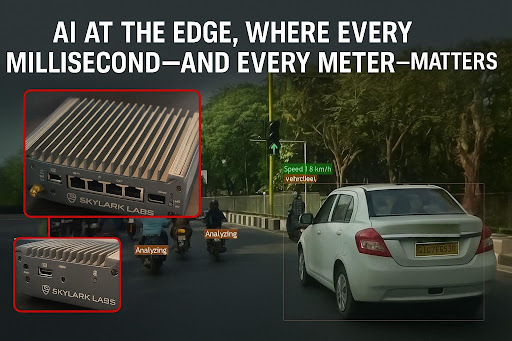

Many of the world’s most dangerous roads are not in dense cities but in rural stretches where connectivity is poor, emergency response is slow, and infrastructure budgets are thin. Skylark Labs is trying to bring advanced road-safety tools to those areas by moving artificial intelligence (AI) from the cloud to the roadside itself.
The company’s brain-inspired, self-learning AI runs directly on low-power devices installed along highways, village roads, and remote corridors. These systems do not depend on high-bandwidth links to data centers. Instead, they process video and sensor data on-site, detect risky behavior, and store evidence locally. It is a design choice that reflects a basic reality: many rural roads do not have reliable cellular coverage, yet they still see speeding, drunk driving, and dangerous overtakes that cost lives every year.
AI on the Rural Roads: How Does It Work?
The challenge on rural routes is not only connectivity; it is unpredictability. Traffic volumes fluctuate between peak harvest seasons and quiet weeks. Lighting conditions vary sharply, with long stretches unlit at night. Weather can change quickly, from clear skies to fog or heavy rain that obscures lane markings. Static models trained only on ideal conditions can degrade quickly, either missing violations or generating a flood of false alarms that operators cannot manage.
Skylark Labs addresses that problem with a self-learning architecture that allows devices to adapt to the specific road segments they monitor. When deployed, an edge unit begins by observing baseline patterns: average speeds, typical gaps between vehicles, and the kinds of maneuvers drivers make to overtake slower traffic.
Over time, it learns what counts as “normal” for that stretch of road. Deviations from that pattern, such as sustained speeding in a known crash hotspot or frequent lane departures in a narrow segment, are flagged for attention.
Because the intelligence sits on the device, this learning loop does not require continuous back-and-forth communication with a central server. Models can update based on local observations. That means the system can remain useful even when connections drop for hours or days. When connectivity is restored, units can synchronize aggregated statistics, violation records, or model updates, but their core safety functions do not depend on being online.
Edge-native enforcement can also help rural regions manage limited budgets. Traditional camera systems that stream raw footage to a central location demand substantial investment in bandwidth and storage, often beyond what smaller municipalities can support. Skylark Labs’ approach compresses the problem. Only relevant metadata, snapshots, or clips associated with confirmed events need to travel to centralized systems for legal handling or analysis. The bulk of processing stays at the edge, reducing ongoing operational costs.
Privacy and data protection considerations apply in rural areas as much as in cities. An edge-based design that keeps most data on-site can make it easier for authorities to demonstrate that they are not engaging in indiscriminate monitoring. The system focuses on specific violations and risk patterns rather than constructing a continuous, centrally stored record of all movement on a road.
Smarter Rural Roads Powered by Self-Learning AI
Rural residents and officials often have a deep familiarity with their roads and the risks they pose. An AI system that can incorporate that local knowledge can be particularly valuable. When officials identify a curve where accidents frequently occur or a stretch where trucks routinely ignore speed limits, edge units can be calibrated to pay closer attention to those spots. As the self-learning AI observes patterns, it can surface new insights, such as times of day when risk spikes or weather conditions that correlate with near misses.
Dr. Amarjot Singh’s broader thesis is that the next wave of mobility AI will not be written only for connected, urban environments. By building systems that address constraints such as limited power, intermittent connectivity, and sparse infrastructure, Skylark Labs aims to extend advanced safety capabilities to roads that have long been underserved by technology. Rural corridors often connect agricultural production, tourism, and cross-border trade. Making them safer can have outsized economic and social benefits.
The company’s model suggests a future in which rural safety programs incorporate self-learning edge AI alongside more traditional interventions, such as signage, education, and patrols. Devices embedded along the roadside quietly monitor behavior, adapt to local conditions, and support authorities with targeted, evidence-based enforcement. Those same devices remain operational even when the network disappears over the horizon.
For communities used to being last in line for technology upgrades, that promise matters. Skylark Labs’ edge-first approach does not guarantee that every remote road becomes safe overnight. It does, however, show how artificial intelligence can be redesigned to serve places where the cloud is not always within reach, but where the need for safer roads is every bit as urgent.