

In Brazil’s Northern Region, a hospital system quietly rewired how physicians make decisions—not with a pilot program or press release, but with a functioning AI platform embedded across the continuum of care, from emergency services to inpatient units and outpatient clinics.
Samel Hospital, a private healthcare institution with 44 years of operation in Manaus, has received a 2026 Global Recognition Award for its work developing and deploying SAMIA (Samel Artificial Intelligence), an AI platform integrated directly into its electronic medical record system. The recognition reflects not an aspiration but a measurable record: a system that clinicians use, that produces consistent results, and that serves a patient population of more than 150,000 covered lives across Northern Brazil.
A Hospital Built To Sustain Long-Term Investment
Samel Hospital operates eight units across Manaus, including three hospitals, five medical centers, and two additional hospital units currently under construction. The institution employs more than 1,000 staff members and works with over 900 physicians providing 24-hour care. It also holds certification from Brazil’s National Accreditation Organization, a designation that reflects the quality and safety standards built into its daily operations.
What distinguishes Samel Hospital’s approach is its vertically integrated structure, which unifies governance, clinical quality, and financial planning under one framework. This model allows the hospital to make technology investments with a long-term view, rather than pursuing innovation as a stand-alone initiative disconnected from clinical reality. Most fragmented healthcare systems cannot sustain that kind of continuity, and the difference shows in how Samel Hospital has been able to develop and scale SAMIA across its entire network.
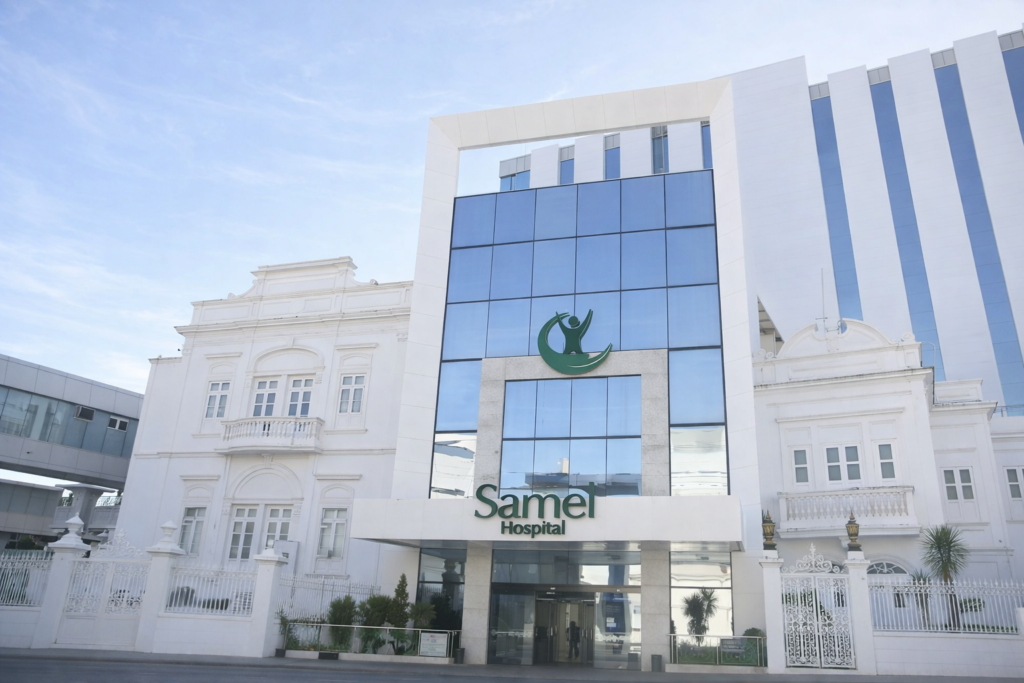
Photo Courtesy of Samel Hospital
The hospital’s stated mission is to provide excellent preventive and curative care through a humanized approach. That mission shapes how resources are allocated and how care is delivered at every level. It functions as a practical framework that connects institutional goals to specific clinical decisions, including the decision to build an AI infrastructure that serves physicians rather than operating alongside them as an afterthought.
What SAMIA Does, And What The Numbers Show
SAMIA was designed to operate within real clinical workflows rather than as an external tool layered on top of existing systems. Its functions include digital pre-triage, structured anamnesis generation, automated clinical summaries, ICD-based diagnostic support, real-time drug interaction alerts, and case-specific discharge guidance, all grounded in evidence-based clinical guidelines. Specialist AI agents within the platform assist physicians in real time, drawing on current medical literature to support decision-making in high-pressure environments.
The performance data behind SAMIA is specific and consistent. A notable 99.85% of AI-generated anamneses require no physician edits in routine practice, reflecting the system’s clinical reliability at scale. Following SAMIA’s deployment in the Emergency Department, the average patient wait time for medical evaluation decreased by 33%, improving access and operational efficiency across the hospital system. Diagnostic support using ICD logic achieves close to 90% accuracy, which strengthens consistency in clinical reasoning in settings where decisions carry significant consequences for patient safety.
Adoption rate and user feedback from clinical staff confirm that SAMIA functions as a tool physicians rely on rather than one they work around, a distinction that matters when evaluating whether AI in healthcare delivers genuine value. “What Samel Hospital has accomplished with SAMIA is not a technology demonstration; it is a functioning clinical system that is making patients safer and reducing the time they wait for care,” said Alex Sterling, a spokesperson for Global Recognition Awards. “That combination of scale, accuracy, and measurable clinical impact is exactly what a 2026 Global Recognition Award for Innovation is designed to recognize.”
A Model With Implications Beyond Brazil
Global Recognition Awards evaluates nominees using the Rasch model, a measurement framework that creates a linear scale across each award category, enabling precise comparisons between applicants. Samel Hospital’s submission was assessed across seven innovation dimensions, including novelty, market impact, technological advancement, adoption rate, and disruption of existing paradigms, earning the highest possible rating in each. The review panel concluded that Samel Hospital’s contributions demonstrate strong, consistent performance across all evaluated dimensions.
Healthcare AI in emerging markets frequently stalls at the proof-of-concept stage. Samel Hospital has moved past that point by deploying tools that clinicians actively use and that produce measurable outcomes at full operational scale. The hospital’s investment in clinical data standardization and digital health infrastructure has built a foundation that supports current AI capabilities and future development as medical knowledge continues to grow.
For healthcare systems in emerging and established markets looking for a concrete example of how to connect digital investment to verified patient outcomes, Samel Hospital’s record in Manaus offers something increasingly rare in the conversation around medical AI: not a promise of what technology might eventually do, but documented evidence of what it is doing now, one patient at a time.