


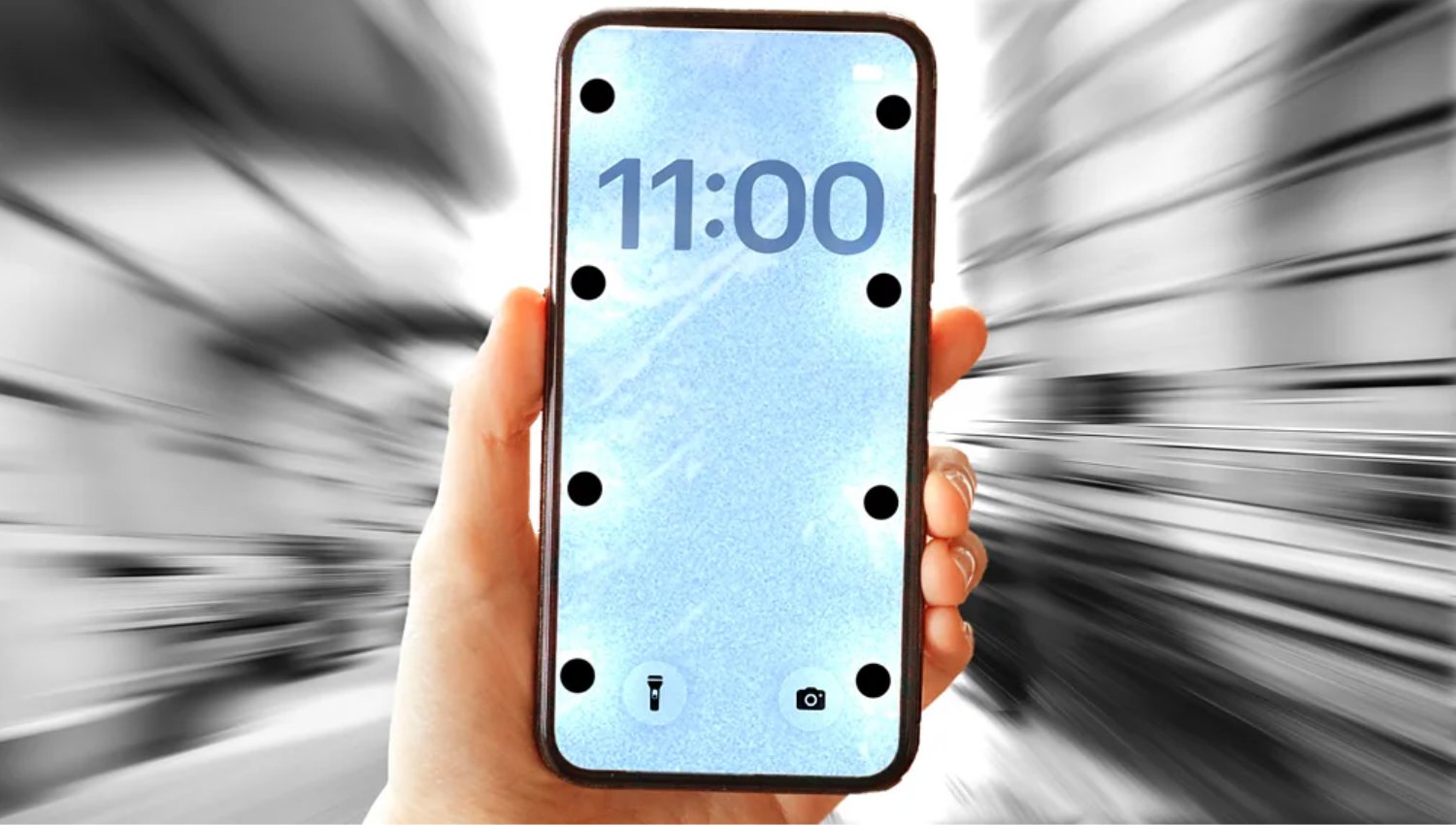
I make a point of not reading over shoulders, but the New York subway does not really allow for that. Bodies pitch about, the train tears through a tunnel, and you catch what you catch. Lately what I keep catching is dots. Small ones, drifting around the edges of other people’s screens.
After the fourth or fifth sighting I had to find out. Everyone with the dots turned out to have one thing in common: they get motion sick.
The setting is called Vehicle Motion Cues, buried in the iPhone’s accessibility menu. It places animated dots along the screen edges, and the phone’s accelerometer moves them in time with whatever vehicle you happen to be in.
Opinion on whether it works is genuinely split. But some people are devoted. One man on the subway told me he liked it enough to leave it running permanently, even standing still, though he declined to give his name to the odd journalist interviewing strangers during rush hour.
If car journeys have always made you queasy, this might be the fix. I was born with an iron stomach, so I cannot speak from experience. What interests me more is the pattern underneath it: our devices creeping further into parts of life they had no business in.
Nobody agrees on what causes it
Something I learned while reporting this: almost everyone who studies motion sickness suffers from it.
Tom Stoffregen, professor emeritus at the University of Minnesota, has been researching the subject since the 1980s. Put him on a cruise ship, he says, and he is in his bunk for three or four days, unable to eat or get up.
The textbook explanation is sensory conflict theory. Your inner ear registers motion while your eyes report a cabin full of objects sitting perfectly still, and the mismatch makes you ill.
Stoffregen thinks that is wrong. His argument is that your muscles and other systems are continuously predicting where your body is about to go in order to hold your posture, and you come undone when those predictions miss. It would explain why passengers suffer and drivers usually do not: the driver is the one making the car move.
Either way, the confusion is what does the damage, according to Kristen Steenerson, a clinical associate professor at Stanford who studies the vestibular system.
Deviation of that kind is what leaves people dizzy or disoriented, she says, and through what she calls some interesting evolutionary coincidences, disorientation drags nausea along with it. Her theory is that we may have evolved to read confusion as a sign we have eaten something poisonous, at which point the body decides vomiting is the sensible response.
Give the body clear signals about how it is travelling through space, Steenerson says, and you can take the edge off. That is the logic the dots run on: they tell you how you are moving.
There is research behind visual feedback, she adds, and evidence it can help a great deal. The same principle sells anti-nausea glasses, filled with liquid that sloshes about as you move. They look ridiculous. They also appear to work.
Steenerson says the dots do something for her own motion sickness, and have become a talking point. Everyone assumes her screen is broken, she says, and she thinks they are terrific.
How to switch it on
Settings, then Accessibility, then Motion, then Vehicle Motion Cues. You can have the dots on constantly or set them to appear whenever the phone detects movement. Android apps do something similar, and there is talk of the feature arriving on Pixel handsets.
Size and colour are adjustable. I have been going about with large purple dots on mine, which starts more conversations than you would think.
Believers and sceptics
Plenty of motion sickness sufferers told me the dots did nothing for them. Others describe them in the language of miracles.
Zandie Brockett, a curator in New York, is firmly in the second camp and calls the setting a game changer. She stops short of preaching about it, she says, but anyone who mentions car sickness in front of her gets the recommendation.
My former boss Rory Carroll said much the same. His case is unfortunate given his job: he is editor-in-chief of Alloy, a car enthusiast publication, and spends a lot of working hours in the passenger seat. An occupational hazard, he calls it. The dots solve something very specific he has dealt with all his life, and in his words, they really work.
The catch
Every convert eventually landed on the same observation. The dots only matter if the reason you feel sick is that you were looking at your phone.
So the prize for fixing your nausea is the freedom to stare at your screen for the rest of the journey. Which, given how many people are already uneasy about their screen time, may not be much of a prize. As Carroll put it, it is a bit of a bummer to lose one more reason not to look at Instagram.