
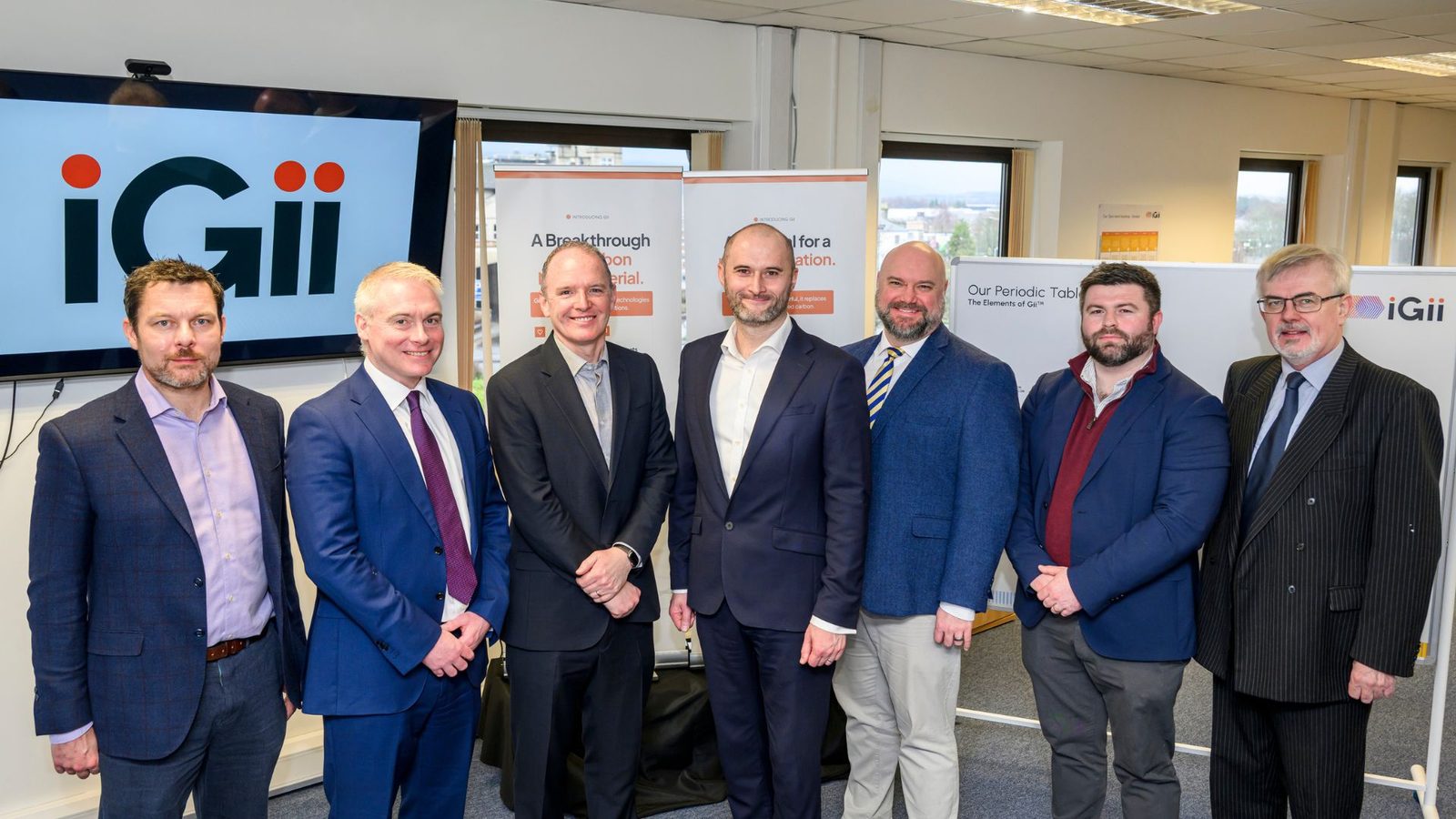

iGii, a materials company based in Stirling, has raised 22.7 million pounds to move its carbon nanomaterial from the laboratory toward large-scale production. The package combines an 11.7 million pound Series B round, led by the Scottish National Investment Bank with PXN Ventures and Archangels, and 11 million pounds of grant support from Scottish Enterprise. The company announced the funding on September 16.
Founded in 2016, iGii developed a three-dimensional porous carbon nanomaterial it calls Gii, which can be grown at room temperature and produced at industrial volumes. The ability to grow the material without high heat is central to the company’s claim that it can be made cheaply and at scale. The firm makes electrodes for the diagnostics and energy sectors, and sees uses across sensing, energy storage and industrial manufacturing. It employs 55 people, including 17 with doctorates, and expects to reach about 70 by year end.
The money is intended to help the company shift from research and development toward commercial delivery. iGii plans to expand its manufacturing capacity, deepen work with manufacturers that could adopt the material and grow its team. Advanced materials have drawn renewed investor interest as industries look for components that can improve batteries, sensors and other hardware, and as governments back domestic supply of critical technologies.
“Every industrial revolution has been enabled by a breakthrough in materials, and this funding means iGii can help enable the next one,” said Jean-Christophe Granier, the company’s chief executive. The pitch places iGii among a group of Scottish deep-technology firms trying to turn university research into manufacturing businesses that can operate at scale.
The backing from a state-owned investment bank and a national economic agency reflects a policy push to build advanced manufacturing in Scotland. Supporters argue that materials science is an area where the country’s universities have strong research but few companies have reached scale. iGii was among a small number of Scottish firms to secure a large materials round during September, and said the funding would carry it through the next phase of scaling production and proving the material can be sold at volume.