

Few corporate functions have faced more scrutiny in the last decade than supply chain management. From pandemic-era shortages to shipping bottlenecks in key transit hubs, volatility has become the rule, not the exception. A 2025 Deloitte Global Supply Chain Resilience Survey found that nearly 70 percent of manufacturers experienced major disruptions over the past two years, costing the industry an estimated $1.3 trillion collectively in delayed production and lost revenue.
Identifying these risks in advance remains one of the most difficult challenges for multinational operations. Traditional monitoring systems track vendor data or shipping KPIs but often miss early indicators, such as supplier insolvency, regional strikes, or subtle regulatory changes, that can ripple through production networks weeks later. Human analysts can’t possibly monitor such vast data fields continuously, leaving most companies reliant on reactive rather than predictive responses.
From Disruption to Detection
Gieni, an artificial intelligence platform developed by Orderfox Schweiz AG, is changing that sequence by using AI agents to monitor and synthesize global market information in real time. They scan millions of sources, from shipping permits and supplier websites to national trade registries and manufacturing job postings. The goal isn’t simply to catalog activity but to interpret it, detecting irregularities or emerging risks before they appear in corporate reports.
When a supplier’s hiring drops unexpectedly or an export license goes unrenewed, these systems flag anomalies for review. Instead of monthly summaries, executives receive alerts contextualized around the company’s operational footprint.
Timur Göreci, Chief Revenue Officer at Orderfox, describes this shift as replacing hindsight with foresight. “Artificial intelligence lets businesses treat supply data like a radar, not a report,” he says. “The aim is to catch turbulence before it disrupts the line, not to piece together what went wrong afterward.”
Predicting the Unseen
The most promising advancement in AI-driven logistics goes beyond merely accelerating data processing; it involves linking signals that once appeared to be unrelated. Gieni fuses structured and unstructured data to recognize patterns that suggest risk escalation: when a particular region’s exports decline at the same time raw material prices rise, or when factory relocations trend toward low-infrastructure areas.
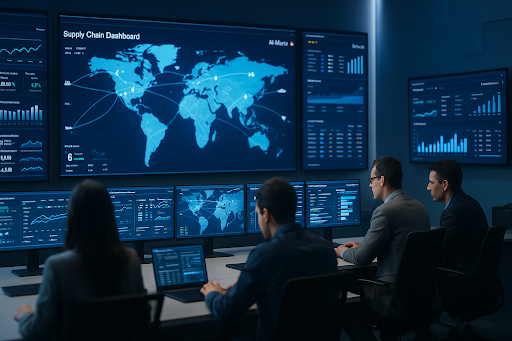
Those correlations help operations managers visualize potential pressure points through live dashboards. Unlike static supplier scorecards, these tools evolve continuously. They also factor in events beyond the supply network, including weather disruptions, regional transport restrictions, and political tension. The broader forecast allows teams to diversify or renegotiate contracts before vulnerabilities compound.
Research by PwC’s 2025 Global Manufacturing Outlook found that manufacturers using predictive analytics for supplier monitoring reported 33 percent fewer critical stoppages than those relying on legacy systems. The results suggest that intelligence at scale is less about automation for its own sake and more about compression, reducing the time between signal detection and enterprise response.
Human Decision in a Machine Timeline
As promising as automation appears, experts caution that responsiveness still hinges on human context. Data alone cannot decide when to switch suppliers or reallocate production lines. Instead, AI augments professional judgment, providing the raw situational clarity managers rarely have in real time.
Derek Tanner, Chief Executive Officer at Orderfox, views this hybrid model as the direction global operations are heading. “You can’t automate accountability,” Tanner says. “What AI delivers is visibility, the chance for decision-makers to see shifts as they’re forming rather than after they’ve already become crises.”
The challenge now for global producers is cultural as much as technological. Organizations must learn to trust machine-derived predictions enough to act decisively, but also to question them intelligently. As Göreci notes, the humans responsible for strategy become stewards of timing and interpretation rather than data triage.
Acting Before It Breaks
For businesses running complex supply lines, AI surveillance tools are becoming less an optional upgrade and more an operational safeguard. They don’t eliminate risk, but they compress its discovery from weeks to moments. That reduction can determine whether an interruption becomes a headline or a footnote.
Managing supply chains will always involve external volatility. But what’s changing is how quickly that volatility converts to risk, and how readily it can be mitigated. With digital agents now embedded in procurement and logistics systems, global manufacturers are learning that foresight isn’t futuristic, it’s already on the dashboard.