
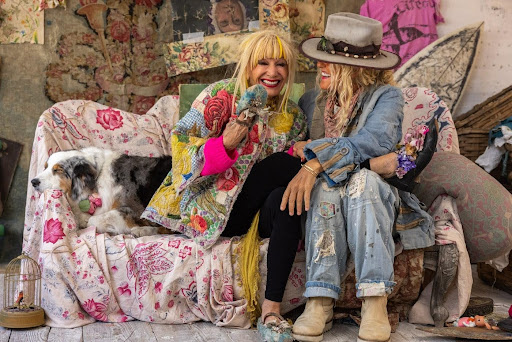

Taylor Swift wore Magnolia Pearl in a music video. Whoopi Goldberg has been photographed in it on television. Blake Lively has carried pieces to film sets. None of these appearances were paid placements. There are no contracts attached to them, no gifting agreements, no publicist negotiations on record. Each was a personal decision made by someone with unlimited access to every label on the market.
The brand has also built licensed creative collaborations with Willie Nelson, Mick Fleetwood, AC/DC, and the Frida Kahlo Corporation. These partnerships produce limited pieces that sit at the intersection of fashion and cultural record — objects that carry the weight of the artists involved and hold their value accordingly. For a label operating out of Fredericksburg, Texas and Malibu, California, the roster reads less like a marketing strategy and more like a natural gathering of people drawn to the same aesthetic sensibility.
Organic celebrity affinity of this kind is difficult to manufacture and impossible to fake. For Magnolia Pearl’s collector base, it functions as a reliable signal of the brand’s cultural weight.
Why the Prices Keep Climbing
Magnolia Pearl garments — hand-distressed, individually stitched, released in small batches that never repeat — have been reselling at two to three times their original retail price for years. The secondary market for the brand is active, competitive, and growing. Production stays limited by design philosophy rather than manufacturing constraint. When something sells out, it does not come back.
To serve that market, Brown launched Magnolia Pearl Trade in 2023. The authenticated resale platform gives collectors a verified space to buy and sell pre-loved pieces, and functions as the only outlet for rare production samples and discontinued items. The global secondhand apparel market was valued at approximately $95 billion in 2024 and is projected to reach $295 billion by 2032, according to industry research. Magnolia Pearl Trade was built for exactly the kind of collector behavior driving those numbers.
The platform charges the lowest seller fees among major resale sites. Every fee collected from third-party transactions flows directly to the brand’s nonprofit arm. The resale market, in this construction, generates charitable funding with each completed sale — a structural link between commercial activity and social giving that requires no separate campaign to maintain.
The Nonprofit With an Auditable Record
The Magnolia Pearl Peace Warrior Foundation was established in 2020 as a registered 501(c)(3) nonprofit. It has distributed more than $550,000 to vetted organizations since its founding. GuideStar filings confirm $268,293 in charitable grants during 2024 alone. Recipients include organizations providing permanent housing to Indigenous American veterans, street veterinary programs for unhoused people and their pets, and arts education initiatives for children in Brooklyn.
The European Commission reported in 2024 that nearly 60% of sustainability and social impact claims made by fashion brands were vague or impossible to verify independently. Magnolia Pearl’s giving sits on the opposite end of that spectrum. The Foundation’s financials are filed, publicly traceable, and specific down to the organizations receiving funds.
Brown grew up in poverty, raised her younger siblings, and spent stretches of her childhood without stable housing. The Foundation’s beneficiary list — housing, food, veterinary care, arts access — reflects that biography directly. The giving is not peripheral to the brand. It is funded by the brand’s transactions, embedded in its resale platform, and documented in a way that withstands scrutiny.