

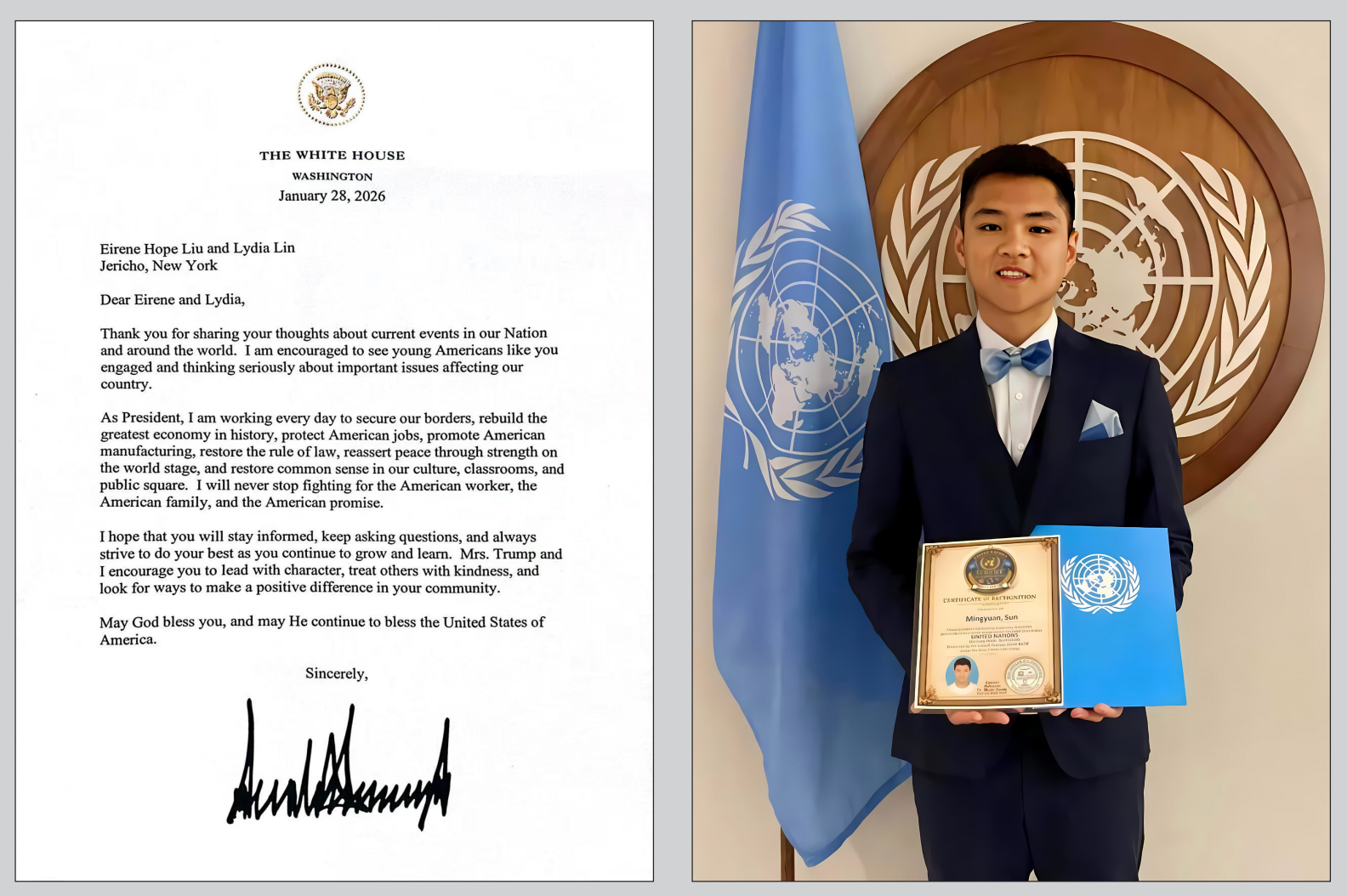

The conference hall at United Nations Headquarters in New York fell quiet as a 16-year-old stepped up to the microphone. His topic was not scoring averages or championship banners; it was a question that pierced into public safety and technology: how might AI serve as a proactive early-warning system for risks on campuses and in public sports spaces? This teenager was Ryan Sun (孙明远), a Chinese-American basketball player who is now a youth delegate speaking on AI and public governance.
To someone glancing at his résumé, Ryan might look like a promising athlete on a predictable rise. On that UN stage, he could pass for a precocious youth delegate granted a rare speaking slot. Extend the timeline, though, and another story appears: a steady arc from the courts of China and Australia to the policy halls of New York, where sport, discipline, and civic responsibility form one continuous thread.
His story stands out not just because he reached the United Nations so young, but because his advocacy is built on lived experience: hours on court, long flights for tournaments, time spent coaching and translating, and careful watching of how crowds behave under pressure. Basketball did not pull him away from public life. It prepared him for it.
From Family Courts To Public Spirit
Ryan’s journey began on the morning courts of an ordinary Chinese neighborhood. He picked up a basketball at three, encouraged by a family that treated sport as character education rather than casual play. His father, who coached the Laos National Men’s Basketball Team to a historic record, turned the game into a classroom and the ball into a daily reminder of responsibility.
At eight, he traveled to Singapore as a young volunteer during the 29th Southeast Asian Games. Watching athletes from different countries compete under many flags, he understood that sport was more than a personal stage. It was a meeting point for cultures, held together by shared rules and respect, even when emotions ran high, and it planted in him a lasting “public perspective.”
Discipline grew alongside that awareness. Ryan pushed through dawn shooting sessions inspired by Michael Jordan’s “Breakfast Club” and Kobe Bryant’s 4 a.m. workouts. While classmates slept, he trained in empty gyms; when others packed for holidays, his suitcase still made room for a basketball and a jump rope. He guarded his academic performance with the same focus, convinced that intellect would carry basketball further and that risks on the court or in the crowd had to be anticipated, not merely endured.
Discipline, Leadership, And The Australian Test
That commitment was tested when Ryan joined the Melbourne Tigers U16 First Team in 2023, competing in Australia’s VJBL league. For the first time, he experienced a tightly run sports organization from the inside, where every weekend depended on coordinating game schedules, venues, logistics, and emergency contingencies. He began watching what happened around the edges of the game as much as the action inside it, noticing how crowd control often relied on staff experience rather than tools or systems, and how moments of confusion or congestion could escalate before anyone recognized a pattern. The conclusion was clear to him: risk in crowded spaces was still largely managed by intuition.
At fifteen, he shifted from being managed to managing others, taking on the role of volunteer head coach for a U12 team in Melbourne while also serving as translator and assistant coach when China’s Women’s U18 National Basketball Team trained there. His squad collected two runner-up finishes and a championship. Still, the real test lay in easing conflicts between children, reading emotional swings before they boiled over, and keeping order when competition turned tense—a small-scale version of public governance in a shared, high-pressure space. Cross-border experiences in 2025, including representing a U.S. team in a Nike tournament in China and accompanying American and Australian coaches to Beijing Normal University, Shanghai University of Sport, and Xi’an Jiaotong University, turned him into a cultural interpreter and tactical explainer, and sharpened his eye for practical problems like poor corridor design and crowd bottlenecks.
When Sport Meets AI Public Governance
Those accumulated observations eventually intersected with his involvement in YLDO, a youth-led organization engaged in public-interest work. During internal discussions, Ryan argued that AI should not stay confined to neat competition projects or abstract prototypes. It should be used where he knew risk was real: entrances, corridors, stands, and shared spaces in schools and sports venues. Drawing on what he had seen in Melbourne, Beijing, Shanghai, and Xi’an, he proposed three key ideas for AI in such environments. Visual recognition and behavioral pattern analysis could build anomaly alerts. Low-intrusion models could be placed at chokepoints, such as entrances and hallways. AI should support human staff, not turn students and spectators into targets of constant monitoring.
His thinking echoed a broader movement in campus safety, where universities in the United States and elsewhere have begun experimenting with AI-powered video analytics to detect unusual crowd behavior, identify threats, and support quicker intervention by security teams. Reports on AI in campus facilities management describe systems that flag anomalies in real time, enabling staff to act before incidents escalate. In youth sports, organizations have also introduced AI elements into training and safety programs to improve situational awareness and reduce harm. Ryan’s proposals fit naturally into this trend. Still, his contribution came with a distinct ethical emphasis: to keep technology as an assistant to human judgment and to protect the dignity of young people in the process.
Institutional recognition followed. On January 28, 2026, U.S. President Donald J. Trump sent a letter acknowledging YLDO’s “AI for Campus Safety” initiative and its youth advocates, including vice president Eirene Hope Liu. For Ryan and his peers, the significance lay less in political endorsement than in the fact that their concerns had entered formal policy discourse. A youth-driven problem statement had moved from internal meetings to a presidential response and, through the UN conference, to an international platform. Ryan later summed up the lesson plainly: “Youth are not bystanders to policy—youth can define the problem.”
Harmony, Peace, And A Larger Arena
The work resonated with groups such as the World Harmony Foundation, a long-standing NGO focused on peace and environmental causes, known for symbolic acts such as its Harmony Bell ceremonies. The World Harmony Bell, cast from recycled ammunition and metals, was created to turn tools of conflict into a call for unity and sustainable peace. In its materials, the foundation stresses that harmony depends on practical safety and shared responsibility, as captured in the line: “true harmony is not silence, but a society where risks are reduced, conflicts are softened, and people feel safe enough to build peace every day.” Ryan’s focus on AI for campus and sports safety reflects that conviction at a youth level.
The foundation has highlighted young leaders whose contributions go beyond symbolic gestures, stressing that “the next generation will not secure peace only through treaties and speeches, but through practical systems that protect students, families, and communities in their daily lives.” Ryan fits that description. He treats policy not as something that lives only in resolutions, but as decisions that must be tested in gyms, corridors, and school gates.
The 2024 invitation from PSA, a respected American basketball academy, signaled that he was no longer viewed solely as a player. Coaches and mentors saw a composite figure: an athlete, a coach, a cultural bridge, and a civic-minded leader. His basketball faith lies less in final scores than in process—discipline, service, contribution, and unity—and the court taught him that the team outweighs the individual, that risks must be anticipated, and that calm judgment matters most when the game is on the line, the same principles that guide his stance on AI for campus safety.
Back in the United Nations hall, his speech on AI and campus safety was measured rather than fiery. Sport, AI, public safety, and youth governance did not feel like separate arenas to him; they formed one continuous court he had been practicing on since childhood. “AI for Campus Safety” may be only the first chapter of his public advocacy, but Ryan Sun (孙明远) already offers a prototype for a youth trajectory rooted in lived experience, strengthened by cross-cultural exposure, and guided by a sense of responsibility larger than personal success.